USA Made Manufacturing Course
Before You Spend Real Money on a Physical Product, Learn What You Are Walking Into. A practical $99 course for founders, inventors, and small business owners trying to bring a physical product to market.
If someone sent you here, or you just found your way here, it is probably because you have an idea, a prototype, a product problem, or a manufacturing question that is starting to get expensive.That is usually the point where people need a clearer path.
Before You Build the Product, Understand the Process
Not a sales pitch. Not someone hyping up the idea. Not a giant consulting bill before you even know what to ask. This course is a place to start.
Calvin Jacobson and Nick Burton walk through the decisions that show up before production:
- Customer need
- Product fit
- Prototypes
- Drawings
- Materials
- Tooling
- Packaging
- Suppliers
- Injection molding
- Production planning
- What happens after a product gets into a customer’s hands.
If you are new to manufacturing, this course helps you understand the process before the larger checks get written.
A Physical Product Can Get Expensive Fast
Most product ideas do not fail in one big obvious moment.
- They get into trouble one decision at a time.
- The product is not defined clearly enough.
- The prototype proves less than you thought.
- The quote does not include everything you assumed.
- The material is not right for the actual use.
- The packaging gets treated like an afterthought.
- The mold locks in a decision too early.
- The first customers expose problems that should have been tested before launch.
- None of that means the idea is bad.
It means physical products have a process, and that process is easier to work through when someone shows you what to look for.
That is why this course exists.
Why $99?
Because free information is easy to ignore, and consulting is not always the right first step.
We built this course to sit in the middle.
Attainable enough to be a practical starting point. Serious enough that people are more likely to
work through it and use it.
Calvin and Nick want this information out there because too many people start spending real manufacturing money before they understand the process.
The wrong early decision can lead to wasted prototypes, confusing quotes, tooling changes, packaging problems, missed timing, or a product that is harder to manufacture than it needed to be.
At the same time, we do not have the time to walk every founder through the full version of this conversation one-on-one before they have done the foundation work.
The $99 course gives you a practical way to get that foundation first.
You can work through the product questions, learn the language, understand the common traps, and get a clearer sense of what your product needs next.
This course is not a replacement for consulting, engineering, design work, legal review,
accounting advice, or a manufacturing partner.
It is a practical first step before those conversations get more expensive.
For some people, the next step will be more research.
For some, it will be another prototype.
For some, it will be a better conversation with a designer, molder, supplier, or manufacturer’s
rep.
For some, it may turn into a deeper conversation with Calvin.
And if you come back to Calvin with the questions and answers you worked through here, that is a useful signal. It shows the conversation can start at a better place, with more context, better questions, and a clearer view of what your product may need next.
If the course helps you realize your product is not ready yet, that is useful.
If it helps you ask better questions before getting quotes, that is useful.
If it helps you prepare for a deeper manufacturing conversation, that is useful.
The point is simple: help you stop guessing before the expensive decisions start.
Three Mistakes That Can Cost More Than This Course
Most product ideas do not fail in one big obvious moment.
- They get into trouble one decision at a time.
- The product is not defined clearly enough.
- The prototype proves less than you thought.
- The quote does not include everything you assumed.
- The material is not right for the actual use.
- The packaging gets treated like an afterthought.
- The mold locks in a decision too early.
- The first customers expose problems that should have been tested before launch.
- None of that means the idea is bad.
It means physical products have a process, and that process is easier to work through when someone shows you what to look for.
That is why this course exists.
Three Mistakes That Can Cost More Than This Course
Mistake 1: Treating a Prototype Like the Product Is Ready
A prototype can be useful and still leave major questions unanswered. It may prove the basic idea works, but that does not mean the product is ready for tooling, production, packaging, shipping, or customers. Before moving forward, you need to understand what the prototype actually proved. - Did it prove function? - Did it prove fit? - Did it prove durability? - Did it prove usability? - Did it prove the material? - Did it prove the package? - Did it prove the product can be made repeatedly? Those are not all the same question.
Mistake 2: Asking for Quotes Before the Product Is Clear Enough
A manufacturer can only quote what has been explained clearly enough to evaluate. That includes use case, material needs, expected volume, tolerances, part size, packaging, tooling assumptions, production path, and how the product will actually be used. If those details are not clear, a quote can give you a false sense of progress. You may get a number. That does not mean the number represents the product you actually need to build.
Mistake 3: Thinking the Mold Is the Finish Line
A mold is a major investment, but it is not the end of the work. After tooling, you still have production runs, material, quality checks, maintenance, packaging, freight, storage, customer instructions, support, and product improvement. The mold helps make the part. It does not automatically make the business work. This course helps you
Built From Both Sides of the Table
This course is led by Calvin Jacobson and Nick Burton, bringing together the manufacturing side and the product owner side of physical product development.
Calvin comes from the manufacturing side. His work is rooted in injection molding, tooling, materials, suppliers, production planning, quality, maintenance, and what has to happen for a part to be made consistently.
His perspective helps explain what manufacturers need to know before they can quote, tool, produce, troubleshoot, or improve a product.
Nick comes from the product side. He has worked through customer feedback, ecommerce, packaging, support, launch timing, product revisions, vendor coordination, and the reality of selling physical products after they leave the factory.
His perspective is shaped by what happens when a product has to survive real customers, real shipping, real instructions, real returns, and real use.
Together, Calvin and Nick walk through product development from both sides of the conversation: the manufacturing partner helping turn an idea into a repeatable part and the product owner trying to bring that part to market.
That combination is the reason this course works. A product does not only need to sound good in a pitch or look good as a prototype. It has to be made, packed, shipped, supported, and improved without the whole business breaking around it.

What the Course Helps You Understand
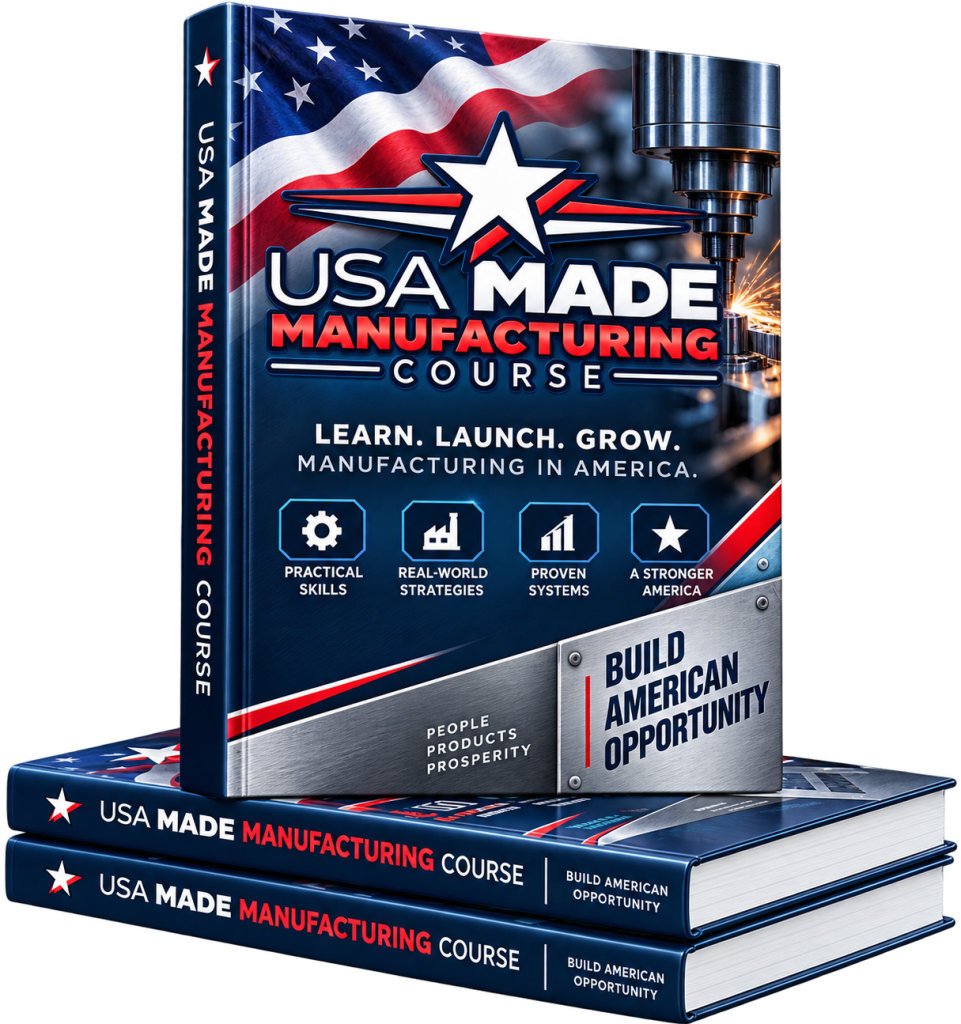
The USA Made Manufacturing Course walks through the product development path from early idea to production readiness.
You will learn how to think through:
- Whether the product solves a real problem
- Who the buyer is
- Whether the idea has a real business path
- How to handle feedback without taking it personally
- What prototypes can and cannot prove
- Why delays create financial ripple effects
- How seasonal timing and shipping affect launch plans
- How to work with a manufacturer’s rep
- How SWOT, SCAMPER, and competitor analysis help organize decisions
- Why form, fit, and function should be tested before tooling
- Why drawings and CAD become the bridge to manufacturing
- How sourcing, packaging, warehousing, and freight affect the real cost
- How beta testers and early customers can expose problems
- Why material selection depends on actual use
- How tooling choices affect cost, timing, volume, and flexibility
- Why mold maintenance and production planning should be discussed early
- How injection molding turns raw material into a finished part
The goal is not to turn you into an engineer.
The goal is to help you become a better prepared product owner.